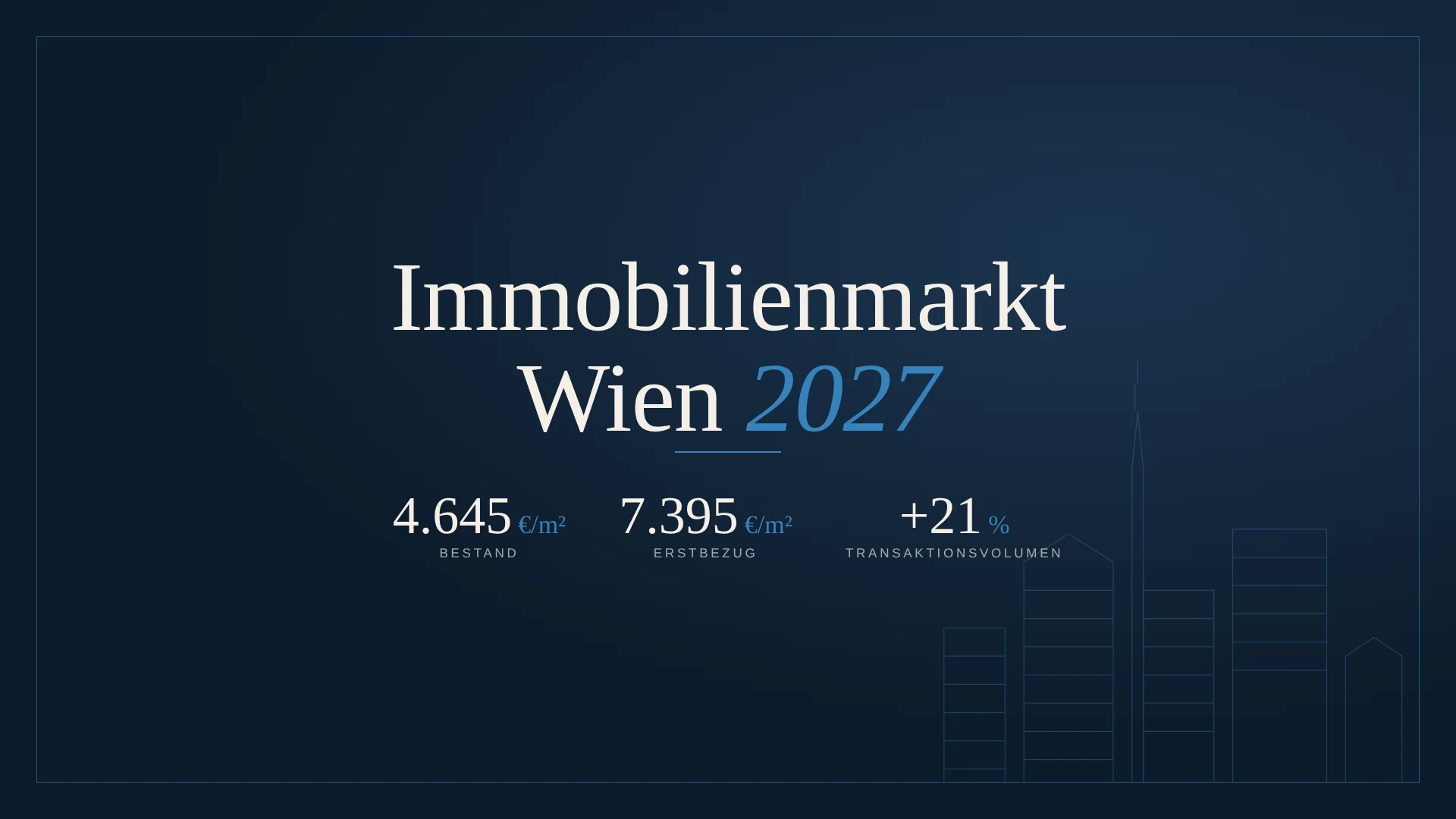
In short: The Vienna real estate market has worked through the correction that began in 2022. In H1 2026, transaction volume for condominiums rose 21% to EUR 1.62 billion, according to OTTO Immobilien. Existing flats average EUR 4,645 per m², first-occupancy new builds EUR 7,395 per m². Across Austria, residential property prices rose 3.9% in H1 2026 (Statistik Austria). For 2027, market observers expect moderate increases rather than jumps: supply is shrinking while demand stays high. The main risk is interest rates, as the ECB raised its key rates in June 2026.
Buyers and sellers in Vienna do not need a crystal ball. They need figures by location and segment. That is what follows.
How is the Vienna real estate market developing right now?
The market has stabilised since the 2022 interest rate turn and is picking up again. Key figures for H1 2026:
Transaction volume: EUR 1.62 billion for condominiums, up 21% year on year (EUR 1.35 billion). That is 8% below the 2022 record (OTTO Immobilien, 8 September 2026).
Number of sales: 4,290, up 18% (prior year: 3,644).
Developer apartments (first occupancy): about 33% of volume, versus an average of 45% before the rate turn.
Austria-wide prices: residential property overall +3.9%, existing flats +4.1% in H1 2026 (Statistik Austria, 23 September 2026).
Long term: according to the Oesterreichische Nationalbank (OeNB), Vienna residential prices rose about 200% from 2000 to 2025, versus about 150% in the rest of Austria. Nationwide, prices fell 3.3% in nominal terms between Q3 2022 and Q4 2025, and 15.1% in real terms.
Eugen Otto of OTTO Immobilien puts it this way: "Demand is there; what is missing is supply." (original: „Die Nachfrage ist da, was fehlt, ist das Angebot.")
Vienna property prices 2026: average price per m²
Two reference points for condominiums:
OTTO Immobilien, H1 2026: existing EUR 4,645/m² (+2.8% versus H2 2025), first occupancy EUR 7,395/m² (H2 2025: EUR 7,376/m²).
EHL Immobilien, H1 2026: first occupancy roughly EUR 5,900–8,100/m², existing roughly EUR 3,700–6,200/m².
New-build prices have moved sideways since H2 2025, while the existing stock is catching up. Location explains most of the spread. Add about 8% purchase costs (land transfer tax 3.5%, land register fee 1.1%, agent and contract fees); see Purchase costs in Vienna.
Vienna property prices by district
A city average says little about your property. Three factors matter more than the overall market:
Inner districts: In the 1st district (Innere Stadt), the 3rd (Landstraße) and around the Ring, prestige, period buildings and scarce space support prices. Sales are rare.
Villa areas: Döbling (1190), Hietzing (1130) and Währing (1180) are driven by owner-occupiers. For houses in districts 13, 14, 16–19 and 21–23, the median price in H1 2026 was EUR 610,000; the 22nd district was the most active with 87 transactions (OTTO Immobilien).
Attic flats and penthouses: terrace, views and finish lift the price per m² well above the district average. See Buying a penthouse in Vienna.
For sellers: use a location-based valuation, not the city average. See Property valuation in Vienna.
Vienna real estate market forecast for 2027
A credible forecast rests on supply, demand and financing costs.
Supply is falling
OTTO Immobilien expects about 12,092 completed apartments in Vienna in 2026 and about 9,608 in 2027, roughly 21% fewer. EHL reports that privately financed rental construction falls from 5,306 units (2023) to a forecast 612 (2027), almost 60% in five years. Figures differ by source and definition; the direction is clear.
Demand stays high
According to EHL, rents rose faster than inflation in all larger segments in H1 2026, which supports ownership as an alternative and as an investment.
Interest rates are the question mark
The ECB raised its key rates by 0.25 percentage points, effective 17 June 2026; the deposit rate is 2.25%. A sharp further rise would slow price growth.
Scenarios for 2027:
Base case (most likely): moderate increases for existing flats, stable to slightly rising new-build prices.
Upside: stable rates and less new supply increase pressure in sought-after locations.
Downside: further rate hikes dampen demand and prices stagnate.
On the 2030 forecast: there is no reliable official price forecast for Vienna to 2030. OeNB, Statistik Austria and the major brokers publish trends for 12 to 24 months. Anything beyond is speculation.
Will Vienna property prices rise or fall?
Short answer: for 2027, more factors point to moderate rises than to falls. A bubble-style crash is not in sight.
Prices have fallen noticeably in real terms since 2022, new supply is shrinking and transaction numbers are rising. The OeNB notes, however, that Vienna prices have diverged from fundamental values since 2011, which calls for caution at very high entry prices. Falls are most likely for overpriced listings or weak building condition.
Interest rates and lending: what buyers should plan for
The binding KIM Regulation expired on 30 June 2025 and was replaced by a non-binding Financial Market Authority (FMA) circular. Guideline values: maximum 90% loan-to-value (about 10% own funds), debt service up to 40% of net income, term up to 35 years. Banks may deviate but must be able to justify it.
The Vienna luxury property market
The luxury segment follows its own rules. It depends less on interest rates because many buyers use little or no financing. It is driven by scarcity: few properties in 1010, 1030 and 1190, hardly any new projects, and an international buyer base from Europe and the Gulf. See New build or period building in Vienna. Non-EU buyers should also read Buying property in Vienna as a foreigner.
What buyers, sellers and investors should do now
Buyers: budget about 8% on top; clarify financing and rate fixation before viewings; judge location and condition before price (Buyer's guide).
Sellers: get a realistic valuation; use the tight supply with a well-prepared property (Selling in Vienna); consider discreet marketing for high-value properties.
Investors: assess yield by location (Zinshaus in Vienna); the drop in rental new-builds supports existing rents; mind tenancy law (Renting out in Vienna).
FAQ
How is the Vienna real estate market developing?
It has stabilised since 2025. In H1 2026, condominium transaction volume rose 21% to EUR 1.62 billion and existing-flat prices rose 2.8% (OTTO Immobilien).
Will Vienna property prices rise in 2027?
Probably moderately. Scarce supply and high demand support prices; rising interest rates slow them.
What does a square metre cost in Vienna?
In H1 2026: EUR 4,645/m² existing and EUR 7,395/m² first occupancy on average (OTTO Immobilien). EHL gives ranges of EUR 3,700–6,200 and EUR 5,900–8,100. Prime locations are higher.
Is there a reliable forecast to 2030?
No. Reliable forecasts cover one to two years; longer figures are scenarios.
Is now a good time to buy in Vienna?
It depends on your goal and financing. Tight supply favours early decisions in good locations; rate fixation, equity and holding period decide. A personal consultation clarifies this.
Conclusion
The Vienna market is moving again in 2026: more sales, moderately rising existing-flat prices and shrinking new supply. For 2027, stability with a slight upward trend is most plausible. Location, condition and interest rates decide.
Want to know what this means for your property or purchase? Our advisers at LANDAA, Kärntner Ring 10, answer discreetly and personally. Arrange a consultation or see our services and current properties.
Sources: OTTO Immobilien, Wiener Wohnmarktbericht H1 2026 (8 Sep 2026); Statistik Austria, Häuserpreisindex Q2 2026 (23 Sep 2026); OeNB, Wohnimmobilien-Marktbericht 2026 (24 Sep 2026); EHL Wiener Wohnungsmarktbericht H1 2026; FMA.
Further reading: Statistik Austria, house price index · OeNB, residential property price index