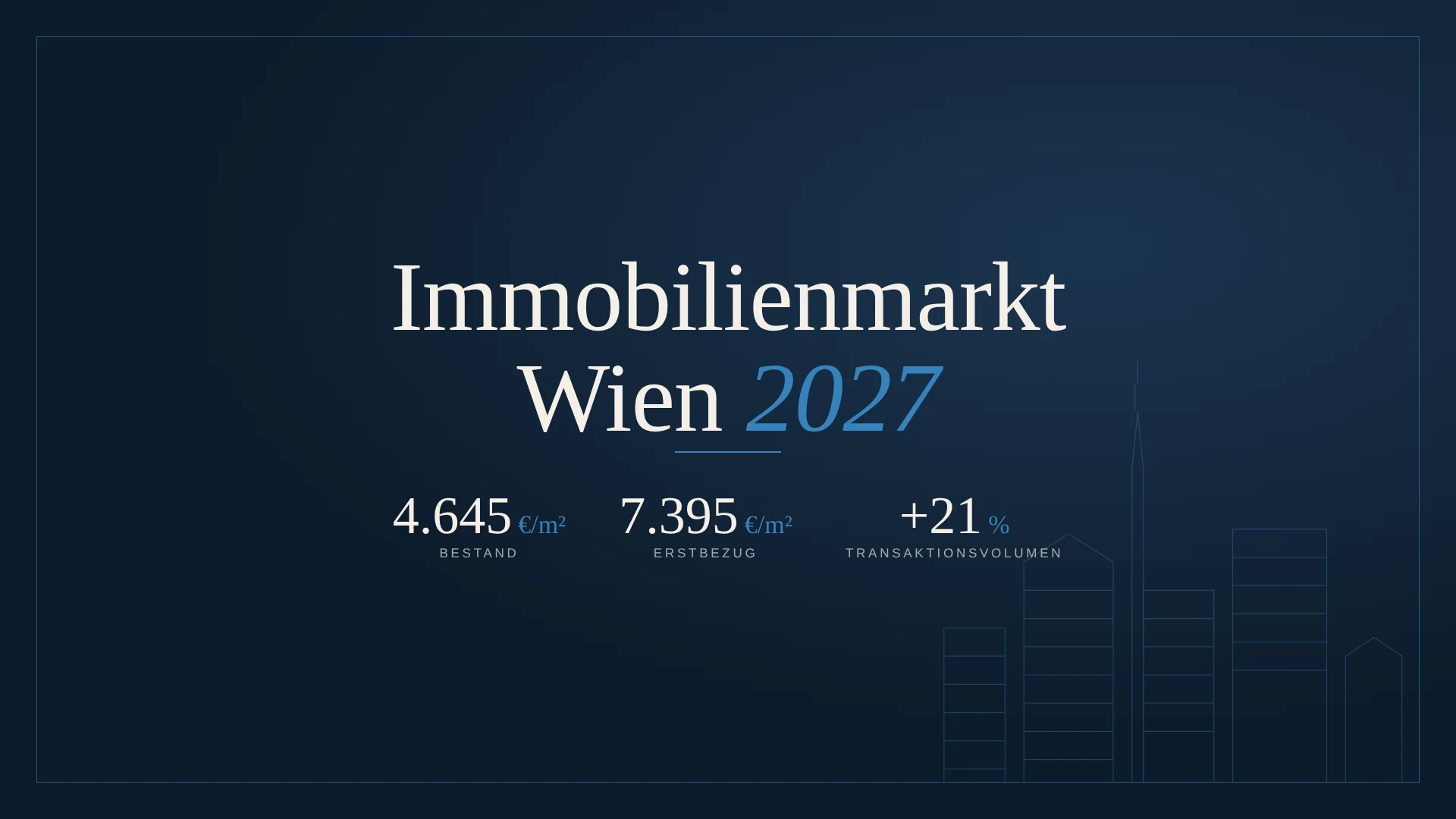
If you want to buy a penthouse or an attic flat in Vienna, expect a price per square metre above the market average. In the first quarter of 2026, new-build first-occupancy flats in Vienna averaged just under €7,300 per m², existing flats €4,536 per m², according to Otto Immobilien. Penthouses usually sit above that, by an amount that depends on location, terrace and views. Add roughly 8 percent in purchase costs.
Four things decide a good purchase: the location, a legally clean terrace, a lift that serves the top floor, and a well-run owners' association. This article shows what a penthouse or attic flat in Vienna costs, which districts from 1010 to 1210 to consider and what to check before signing.
Penthouse or attic apartment: what is the difference?
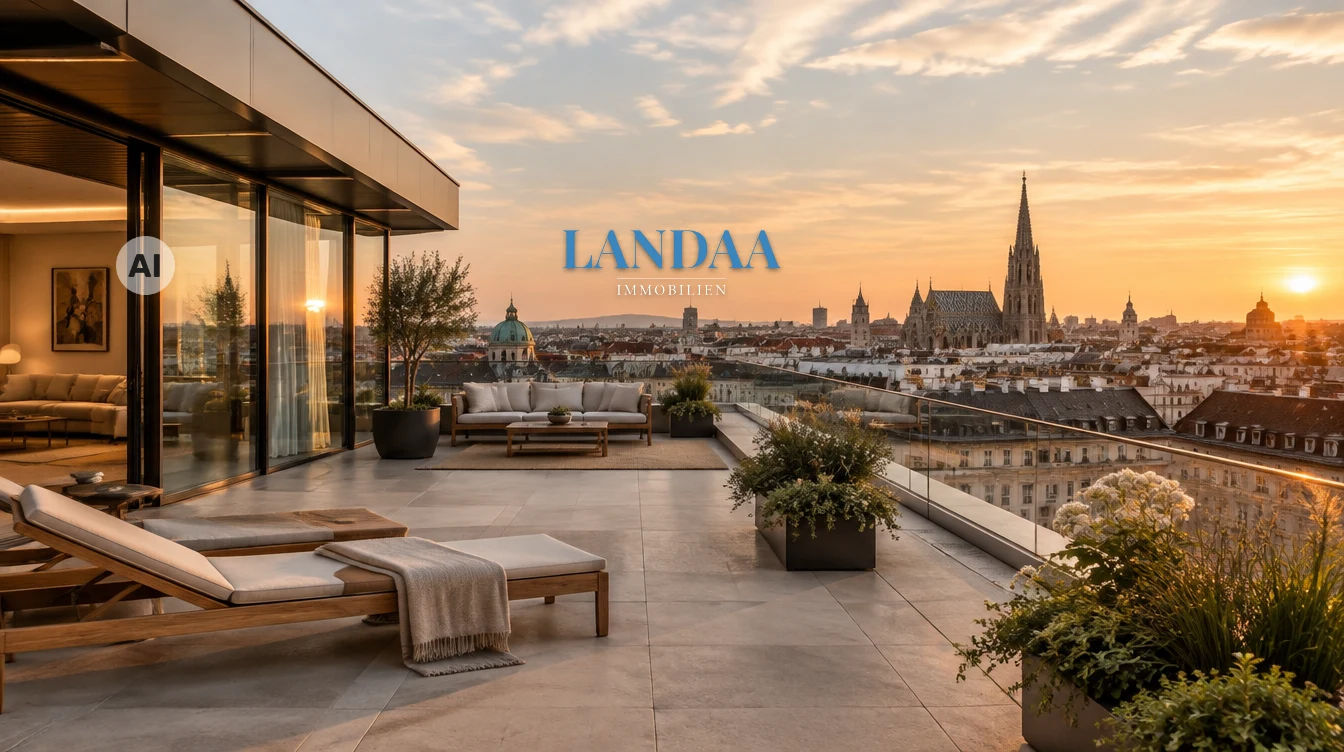
"Penthouse" is not a legal term. On the Vienna market it means an apartment on the top floor, usually with a set-back roof terrace, large glazing and a lift stop of its own. An attic apartment (Dachgeschosswohnung) is the broader term: it sits under the roof, may have sloping ceilings and is often a loft conversion in an older building.
Penthouse: the terrace is the centrepiece, typically new-build or a high-end rooftop extension, with views over the rooftops.
Attic apartment: the charm of dormers and timber beams, often in a Gründerzeit building, not always with a terrace.
Common ground: both are condominium units and depend legally and technically on the building beneath them.
Ownership, not renting: buying an attic flat in Vienna means acquiring condominium ownership together with a co-ownership share in the house and land. Your rights and duties towards the other owners follow the Condominium Act (WEG) and the condominium agreement.
How much does a penthouse in Vienna cost?
There is no reliable "average penthouse price", because every unit is unique. Vienna's market reports give orientation:
New-build (first occupancy): just under €7,300/m² in Q1 2026 (Otto Immobilien).
Existing stock: €4,536/m² on average in Q1 2026 (same source).
Range: new-build roughly €5,900 to €8,100/m² depending on location and finish, resale roughly €3,700 to €6,200/m² (EHL market report, H1 2026).
Trend: according to EHL, owner-occupier prices have stabilised and are rising moderately in individual locations while supply gets tighter.
An illustration, not a market price: 150 m² at €7,300/m² comes to roughly €1.1 million before terrace, location and finish are added. In prime central locations penthouses are noticeably higher.
Market outlook 2026: why penthouses stay scarce
According to the EHL market report for the first half of 2026, demand for owner-occupied flats in Vienna is back at pre-rate-hike levels while both new-build and existing supply tighten. EHL expects the supply gap to widen over the coming quarters. For penthouses this holds even more strongly: each building has only a few top floors, and new roof extensions arise mainly through additional storeys and densification. If you want a specific property in a specific location, you need patience, a clear budget and the readiness to decide fast when the right listing appears.
Attic flats in Vienna: districts at a glance
The district shapes price, buyer pool and resale value more than any other feature. There are no reliable penthouse prices per district, so we describe character and buyer profile here rather than square-metre figures.
Innere Stadt (1010): the Ringstrasse and St. Stephen's in view
Penthouses and attic flats here are rare and almost always one-offs in historic buildings. If you want to buy an attic flat in 1010 Vienna, you pay for address, discretion and view rather than floor area. New-build supply is minimal, so access to off-market listings matters.
Leopoldstadt (1020) and Landstrasse (1030): Prater, Danube Canal, Belvedere
For an attic flat in 1030 Vienna or the 2nd district, the area around the Belvedere, Rennweg and the Danube Canal offers modern projects with roof terraces that live off the city view. Interesting for investors, with strong infrastructure.
Wieden (1040), Margareten (1050), Neubau (1070) and Alsergrund (1090): Gründerzeit with roof conversions
In these districts many attic flats come from the conversion of Gründerzeit houses, for example around Karlsplatz, Spittelberg or the Servitenviertel. The appeal is period charm, closeness to the centre and a lively neighbourhood. Check particularly carefully whether the conversion and terrace are permitted.
Döbling (1190), Währing (1180) and Hietzing (1130): green and quiet
For a penthouse with a garden feel, look towards Türkenschanzpark, the vineyards and Schönbrunn. The appeal is calm, villa surroundings and long views, popular with families and buyers who want the city close but not loud.
Hernals (1170) and Floridsdorf (1210): more space for the budget
For an attic flat in 1170 Vienna or the 21st district, you often get more floor area and terrace for the same budget. Hernals scores with its closeness to the Vienna Woods, Floridsdorf with U1 and U6 connections as well as the Danube Island and New Danube.
Vienna or surrounding area: an attic flat in Lower Austria?
Searching around Vienna, for example in Klosterneuburg or Mödling, often gets you more living space for the money. In return you have commuting times and different infrastructure, and international buyers face Lower Austrian land-transfer law rather than Vienna's.
Penthouse or attic flat in Vienna with a terrace: legal checks
The terrace drives the price and is the most frequent source of disputes. Before buying, check:
Accessory condominium title (Zubehör-Wohnungseigentum): does the terrace belong to the unit under the condominium agreement and valuation report, or is it a common part with a mere right of use?
Plans versus what was built: in a 2020 case on converted attic flats with terraces, galleries and roof windows, Austria's Supreme Court confirmed that serious deviations from approved plans can require the consent of all co-owners or a court substitute (OGH 5 Ob 222/19m, 19 Nov 2020).
Maintenance: who pays if the roof terrace leaks, you or the community? The contract and the property manager decide.
Usable area: terraces usually do not count in full towards living area. Check how they were priced in.
Have a lawyer or notary review these points before signing. This article is not legal advice.
What to check when buying an attic apartment: the checklist
Lift: does it reach the top floor, open into the flat, or stop at the stairwell?
Roof and waterproofing: roof age, insulation, condition of the terrace seal.
Summer heat: shading, glazing, cooling and whether outdoor units are permitted.
Reserve fund and resolutions: size of the repair reserve, planned works, minutes of recent owners' meetings.
Energy certificate: heating demand and the building's heating system.
Long-term views: what may be built on neighbouring plots? An open view is only as secure as the zoning.
Noise and building services: ventilation plant and lift machinery often sit directly under the roof.
Parking and storage: a garage space adds value and resale appeal in the luxury segment.
For when older buildings beat new-builds and vice versa, see Neubau oder Altbau Wien.
Luxury-segment finish: how to recognise a good penthouse
Beyond location and terrace, finish separates a good penthouse from an excellent one. Look at ceiling heights and window area, the quality of the glazing (thermal and acoustic insulation), underfloor heating or thermally activated slabs, and a terrace with water and power points, shading and wind protection. A private lift with direct access adds comfort and discretion, and cooling is no longer a luxury in summer but a daily need.
Ask about building services as well: who maintains the lift, ventilation and heating, and what are the monthly running costs? With large terraces and glazing they run higher than the brochure suggests. If you are buying to live in the flat, put running costs and the reserve fund into the total calculation, not just the purchase price.
Purchase costs: plan for about 8 percent
On top of the price you typically pay real estate transfer tax (3.5 %), land register entry (1.1 %) and, where applicable, agent's commission (up to 3 % plus 20 % VAT). Together that is about 8 percent. On €1.5 million that is around €120,000 extra. The full breakdown and current special rules are in Nebenkosten Immobilienkauf Wien 2026.
Buying a penthouse in Vienna: six steps
Define your search profile: district, area, terrace, budget, use. With a search mandate you see suitable properties before they are published.
View at two times of day: morning and evening reveal light, noise and heat.
Review documents: land register extract, condominium agreement, valuation report, plans, energy certificate, minutes, reserve.
Benchmark the price: compare with real closings, not asking prices. See Immobilienbewertung Wien.
Contract and escrow: drafted by a lawyer or notary, payment via escrow account.
Handover: protocol with meter readings, keys and a defects list.
International buyers should clarify early whether land-transfer approval is needed: buying property in Vienna as a foreigner. The general process is in the buyer's guide.
A penthouse as an investment: opportunities and limits
Penthouses are scarce, which supports value. The pool of tenants is small and expectations high, so vacancies can last longer than with a standard flat. Whether rent can be agreed freely depends on the building and the date of its building permit and should be checked before purchase. For rental basics see renting out an apartment in Vienna.
Penthouse agent in Vienna: when guidance pays off
A large share of penthouses is placed discreetly. A licensed agent knows properties before they go online, reads terrace and property management with a trained eye and negotiates in the buyer's interest. LANDAA has accompanied buyers and sellers of high-end property in Vienna since 2009. See our services.
Frequently asked questions
How much does a penthouse cost in Vienna?
There is no single price. As a guide: first-occupancy flats average just under €7,300/m² (Q1 2026), existing flats about €4,536/m². Penthouses sit above that depending on location, terrace and views. Add about 8 % purchase costs.
What is the difference between a penthouse and an attic apartment?
In market usage a penthouse is a top-floor flat with a roof terrace, usually new-build. An attic apartment sits under the roof, may have slopes and is often a conversion in an older building. Neither term is legally defined.
Which districts have the most penthouses?
Most sought after are the Innere Stadt (1010), Landstrasse (1030) and Leopoldstadt (1020), the Gründerzeit districts 1040, 1050, 1070 and 1090, and the green districts Döbling (1190), Währing (1180) and Hietzing (1130). Hernals (1170) and Floridsdorf (1210) are more budget-friendly.
What should I check when buying an attic apartment?
Lift, roof and terrace waterproofing, summer heat, reserve fund, the legal status of the terrace and long-term views.
Can I buy an attic flat in Vienna as freehold ownership?
Yes. You acquire condominium ownership with a co-ownership share in the house and land. The condominium agreement, the valuation report and the legal status of the terrace matter.
Do foreigners need approval?
It depends on nationality and residence. Non-EU buyers in Vienna often need approval under land-transfer law. Have this checked before signing.
Conclusion: buy a penthouse in Vienna with clear eyes
A penthouse is a lifestyle and a scarce asset. If you check location, terrace and building carefully, you buy not only a view but a value that holds. Talk to us about your search profile: book a consultation.