
In short: Yes, you may sell property in Austria without an estate agent. You save the seller's commission of up to 3% plus 20% VAT, which is up to EUR 28,800 gross on a EUR 800,000 sale. That saving disappears quickly: pricing just 3% too low costs the same. You also carry liability for the contract and the energy certificate, you must vet buyers, and you pay the real estate capital gains tax (ImmoESt). For older holdings, the effective rate rises from 4.2% to 6% of the sale price on sales after 31 December 2026. A private sale needs a solid valuation, a notary or lawyer as escrow agent and a clear timeline.
This article shows what a sale without an agent really costs in Vienna, how the process works and when the commission still pays off.
Can you sell property in Austria without an agent?
Yes. There is no obligation to use an agent. Two points remain non-negotiable:
Written purchase contract: signatures must be certified for land register entry. In practice, a notary or lawyer drafts the contract.
Tax handling: the notary or lawyer usually calculates and pays the capital gains tax for you (self-assessment).
Everything else, from pricing to advertising and negotiation, is up to you. That is where most mistakes happen.
What does an estate agent cost when selling in Vienna?
Austria has no "ordering party pays" rule for purchases; that applies to residential rentals only (§ 17a MaklerG, since 1 July 2023). On a sale, buyer and seller usually each pay a commission.
Maximum per side: generally 3% of the price plus 20% VAT, i.e. 3.6% gross.
EUR 450,000: EUR 13,500 net, EUR 16,200 gross per party.
EUR 800,000: EUR 24,000 net, EUR 28,800 gross.
EUR 1,500,000: EUR 45,000 net, EUR 54,000 gross.
Due: when the purchase contract becomes legally effective, not at land register entry.
Selling privately: the process in 7 steps
Establish the value: use a location-based valuation, not the city average. See Property valuation in Vienna.
Collect documents: land register extract, energy certificate, floor plans, operating cost statements; for condominiums also the ownership agreement, reserve fund balance and owners' meeting minutes.
Create the listing: honest details on condition, heating, running costs and energy certificate values.
Run viewings: only with buyers whose financing has been clarified.
Negotiate: price, handover date, inventory, warranty.
Contract and escrow: a notary or lawyer drafts the contract and handles payment, deletion of old charges and land register entry.
Handover and tax: keys, meter readings, notice to the property manager, capital gains tax through the notary or lawyer.
The biggest risks of selling without an agent
Risk 1: the price is wrong
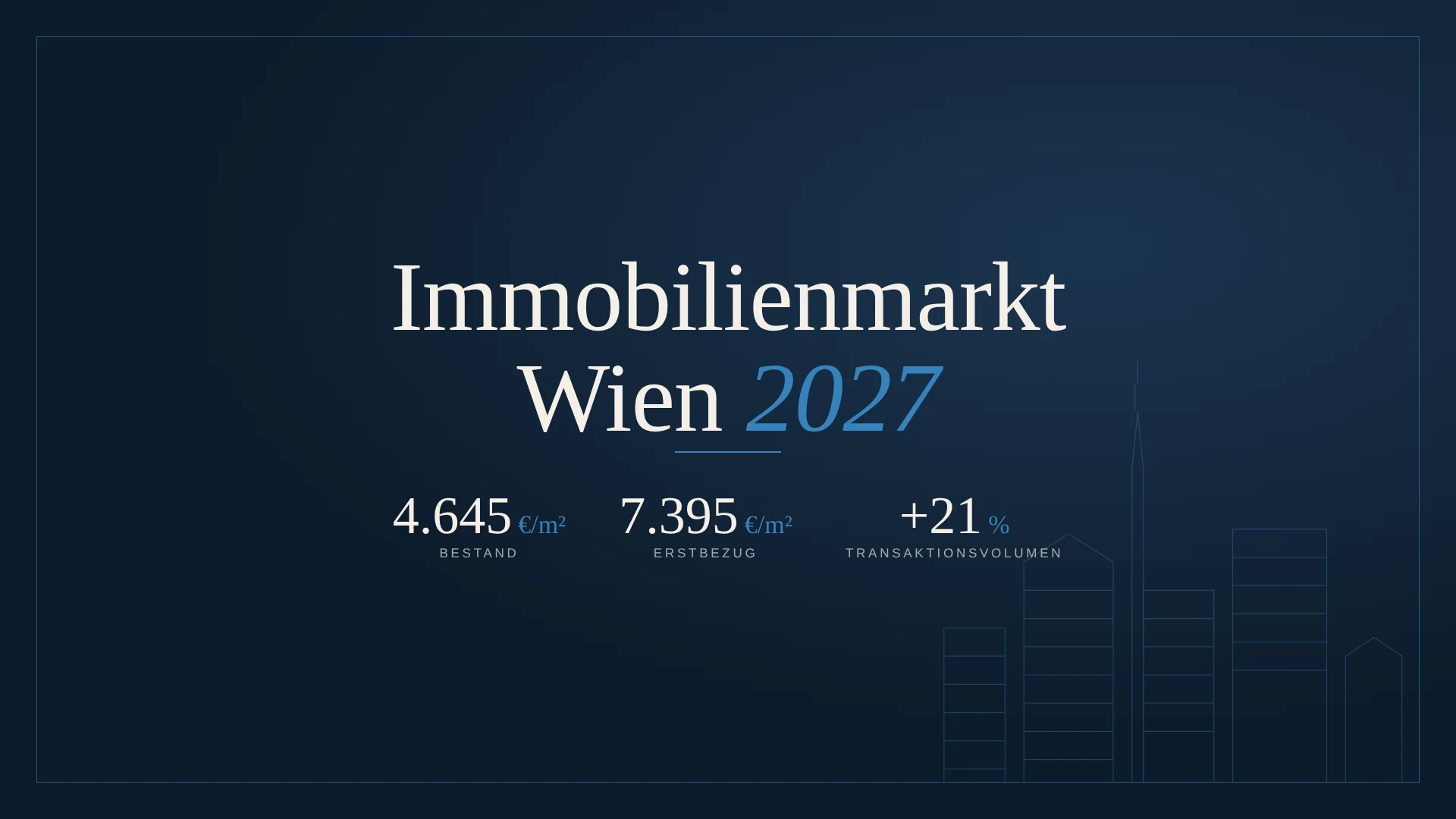
Too high and the property sits; too low and you give money away. EHL reports roughly EUR 3,700 to 6,200 per m² for existing condominiums in Vienna in H1 2026. For 100 m², that is a EUR 250,000 spread depending on location and condition. See also Vienna real estate market 2027. A price well below half the true value can also make the contract challengeable (§ 934 ABGB).
Risk 2: buyers without secured financing
Ask for proof of financing or equity before viewings. For high-value sales, the notary's or lawyer's anti-money-laundering checks on the source of funds can take time, especially with international buyers. See Buying property in Vienna as a foreigner.
Risk 3: liability for statements and defects
You are liable for warranted features and must disclose known defects. A concealed damp problem, undeclared conversions or wrong floor areas lead to warranty or damages claims. Have the contract reviewed, especially warranty clauses and fixtures.
Risk 4: security for the purchase price
Never hand over the title against a signature alone. In escrow, a notary or lawyer holds the price in a trust account and releases it once all conditions are met. See oesterreich.gv.at.
Risk 5: tax and time
Tax is often underestimated; see below. Viewings, questions and negotiations also take time and availability.
Energy certificate: mandatory in every sale
Under the Energy Certificate Presentation Act (EAVG 2012):
the certificate must be no older than ten years;
you must show it to interested buyers in good time before the contract;
the buyer receives it, or a complete copy, within 14 days of signing;
the duty cannot be waived by contract.
Source: oesterreich.gv.at.
Real estate capital gains tax: what changes in 2027
Since 2012 there is no speculation period. Gains from private property sales are taxed at a special rate of 30%.
How ImmoESt is calculated
Property bought after 31 March 2002: the actual gain (proceeds minus acquisition cost).
Property bought before 31 March 2002: a flat acquisition cost may be used. Until 2026: 86% of proceeds, which gives an effective 4.2%.
Rezoned to building land after 31 Dec 1987: flat 40%, effective 18%.
Main-residence exemption: no tax if the property was your main residence for at least two years continuously from acquisition, or for five of the last ten years, and you give it up (plots up to 1,000 m²). It does not pass to heirs or donees.
Handling: if the notary or lawyer also calculates the land transfer tax, they pay the ImmoESt for you. Otherwise an advance payment is due by the 15th of the second month after you receive the price.
New from 1 January 2027: older holdings get more expensive
Under the Budget Accompanying Act 2027–2028 (Federal Law Gazette I No. 62/2026), the flat acquisition costs for older holdings fall. The 30% rate stays; the effective burden rises:
No rezoning: from 4.2% to 6% of the sale price (flat 80% instead of 86%).
Rezoned after 31 Dec 1987: from 18% to 21%.
Rezoned after 31 Dec 2024 (with rezoning surcharge): from 23.4% to 27.3%.
The new rates apply to sales after 31 December 2026; the binding purchase agreement is decisive according to professional literature. Example: on a EUR 1,000,000 sale, the tax on non-rezoned older property rises from EUR 42,000 to EUR 60,000, an extra EUR 18,000. Newer holdings and the main-residence exemption are unchanged. If you own older property, ask a tax adviser or notary now whether signing in 2026 makes sense.
With or without an agent: when does what pay off?
Selling alone can work if you already know the buyer, the property is standard and you have time and market knowledge.
An agent is usually worth it for high-value or unusual properties (a penthouse, a representative flat in the 1st or 19th district), discreet sales, international buyers where foreign-buyer rules and source of funds need clearing, or when you cannot run viewings yourself. A price 2% to 3% higher through experienced negotiation covers the commission. An honest agent tells you whether that is realistic before you sign. See Our services and the guide to selling in Vienna.
Checklist: documents for a private sale
Current land register extract
Energy certificate (max. 10 years old)
Ownership agreement and allocation of shares (condominiums)
Latest operating cost statement
Reserve fund balance, minutes and planned renovations
Floor plans and area data
Proof of conversions and permits
Leases, if rented
Bank confirmation on release of mortgages
FAQ
How do I sell my property without an agent?
Get a valuation, assemble documents and the energy certificate, advertise, vet buyers' financing, and have a notary or lawyer draft the contract and handle escrow.
Is selling without an agent worth it?
You save up to 3.6% of the price but carry pricing risk, liability and time alone. It can pay off for standard property with certain demand, less often for high-value or discreet sales.
Who pays the agent's commission on a sale?
There is no ordering-party rule for purchases. Buyer and seller usually each pay up to 3% plus 20% VAT. If you sell without an agent, your commission falls away.
What does a sale without an agent cost besides tax?
Energy certificate, valuation, listing, release of existing mortgages and possibly advice. Contract drafting and land register costs are usually borne by the buyer; the contract should say so.
How does ImmoESt change in 2027?
For older holdings the effective rate rises from 4.2% to 6% (no rezoning) and from 18% to 21% (rezoned), for sales after 31 December 2026.
Conclusion
Selling without an agent is allowed. The real question is whether a commission of up to 3.6% costs more than it delivers: a reliable price, vetted buyers, clean contracts and discretion. For simple property with a known buyer, selling alone can pay. For high-value property, international buyers or time pressure, such as the 2027 tax change, professional support is usually cheaper.
Want to know which route we would recommend for your property? Our advisers at LANDAA, Kärntner Ring 10, review your plans discreetly and without obligation. Arrange a consultation or see our services and current properties.
Sources: oesterreich.gv.at; WKO, private property sales and tax (1 Jul 2026); Notar Reitter (23 Jul 2026); Brandauer Rechtsanwälte (10 Jun 2026; 27 Apr 2026); EHL, Wiener Wohnungsmarktbericht H1 2026. This is general information, not legal or tax advice.
Further reading: WKO, private property sales: tax · oesterreich.gv.at, energy certificate